
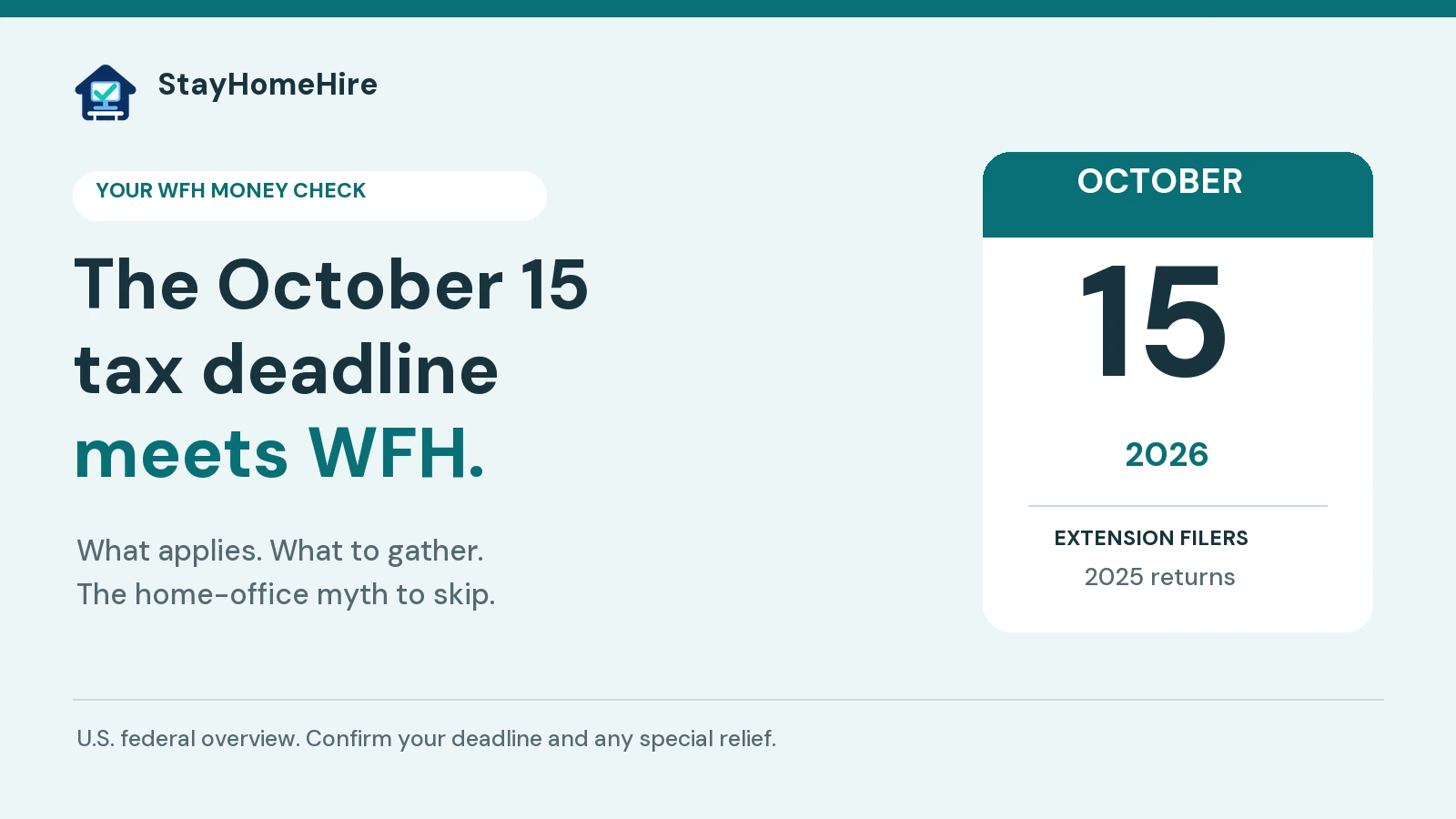
Your workday is already full. Then the calendar taps you on the shoulder: October 15. If you extended your 2025 U.S. federal tax return, today may be your filing deadline. Suddenly, that folder called “tax stuff” deserves a better name and your full attention.
Here’s how I’d approach it: confirm which deadline applies, gather the right year’s records, and keep “I work from home” separate from “I qualify for a deduction.” The couch is comfortable. It is not a tax strategy.
Checked October 15, 2026. This guide concerns U.S. federal individual income taxes. It is general information, not personal tax advice. State rules and special extensions can differ.
What is actually due today?
For most calendar-year individuals who obtained a valid six-month extension, October 15, 2026, is the deadline to file their 2025 federal income tax return. It is not the filing deadline for income you earn during 2026. The IRS confirms these dates in Publication 17 for 2025 returns.
An extension gave you more time to file, generally not more time to pay. For most people, 2025 federal tax was due April 15, 2026. An unpaid balance can bring interest and penalties. If you never requested an extension, do not treat today as a new grace period: the IRS says to file as soon as possible.
Before assuming today applies, check the IRS’s disaster relief notices. Relief depends on the affected location and notice. Combat-zone service and some overseas circumstances can also change deadlines; Publication 17 explains the exceptions. Working remotely by itself does not extend your filing deadline.
Your deadline-day checklist
- Open your 2025 records. Gather W-2s, applicable 1099s, other income records, relevant receipts, and estimated-payment confirmations. Keep 2026 documents in a different folder. Two years mixed together is a headache nobody ordered.
- Match income to your records. Include freelance and gig income even when no tax form arrived. The IRS Gig Economy Tax Center explains that side-work income can be reportable without a 1099. A missing form is not permission to leave income out.
- Review the basics before sending. Check names, identification numbers, filing status, bank details, and tax payments already made. Resolve unfamiliar entries with your preparer or official guidance rather than guessing.
- File and address any balance. If you cannot pay everything, the IRS still recommends filing and paying what you can. Review official payment-plan options; eligibility, fees, interest, and penalties matter. A payment arrangement is not a tax cancellation.
- Save the proof. Keep your return, submission receipt, acceptance or rejection notice, and payment confirmation. Watch for rejection messages that require action. Clicking “send” and knowing your return was accepted are two different checkpoints.

WFH does not automatically mean a home-office deduction
Remote employee: If you are a W-2 employee working from home, do not claim a federal home-office deduction for that employee work. The IRS’s current home-office guidance makes the employee restriction clear. Buying a desk or paying your internet bill does not change your employment status.
Self-employed worker: You may qualify, but eligibility comes first. Business use generally must be regular and exclusive, with a qualifying business purpose such as your principal place of business. Specific exceptions exist, including certain daycare and inventory uses. IRS Publication 587 explains the tests and calculation methods. A receipt proves a purchase; it does not prove a deduction.
Illustrative example: Someone answers customer calls from a spare room as an employee. Another person uses a dedicated room exclusively and regularly for a qualifying freelance business. Both work at home; their federal home-office treatment is different. Someone with both employee and freelance income needs to examine the business use separately.
My recommendation: ask a qualified tax professional about a questionable claim, especially if you moved, worked across state lines, or have mixed income. Do not let a social post talk you into a deduction your records cannot support.
Check the free filing route before paying
The IRS says 2025 filers with adjusted gross income of $89,000 or less can use IRS Free File guided federal preparation, subject to the chosen partner’s eligibility rules. Free File Fillable Forms are available regardless of income, but suit people comfortable preparing their own return. Eligible military households can check MilTax.
Enter through IRS.gov’s free filing page and check federal and state coverage before choosing. Free federal filing does not automatically mean a free state return. The IRS lists Free File availability through October 15, 2026, so check today’s availability and do not leave transmission to the final minute.
Make the next tax season less dramatic
Once this return is handled, create one secure 2026 folder and a short monthly reminder to update it. Employees can review the IRS Tax Withholding Estimator, especially after changing jobs or income. Contractors should check whether estimated payments apply instead of picking a random savings percentage from the internet.
Our remote worker’s fall tax checklist gives you an organizing routine. Keep that separate from today’s deadline task: finish what applies to 2025, then build a better system for 2026.
Quick questions
Do all remote workers need to file today?
No. Today’s general deadline concerns valid extension filers’ 2025 federal individual returns. Your filing requirement and any special relief depend on your situation.
Should I wait to file until I can pay?
The IRS says to file even if you cannot pay the full balance. Pay what you can and check official payment options.
Does an extension cover my state return too?
Do not assume so. Check your state tax agency’s filing, payment, and extension rules, particularly if you lived or worked in more than one state.
Ready to focus on your next career move? Search StayHomeHire’s free job listings, or use the Resume Center to prepare your application. Those tools help with the job search; your tax return belongs with the IRS, your state agency, or a qualified preparer.